

Originally published in Japanese in July 2023.
Based on a Japanese video.
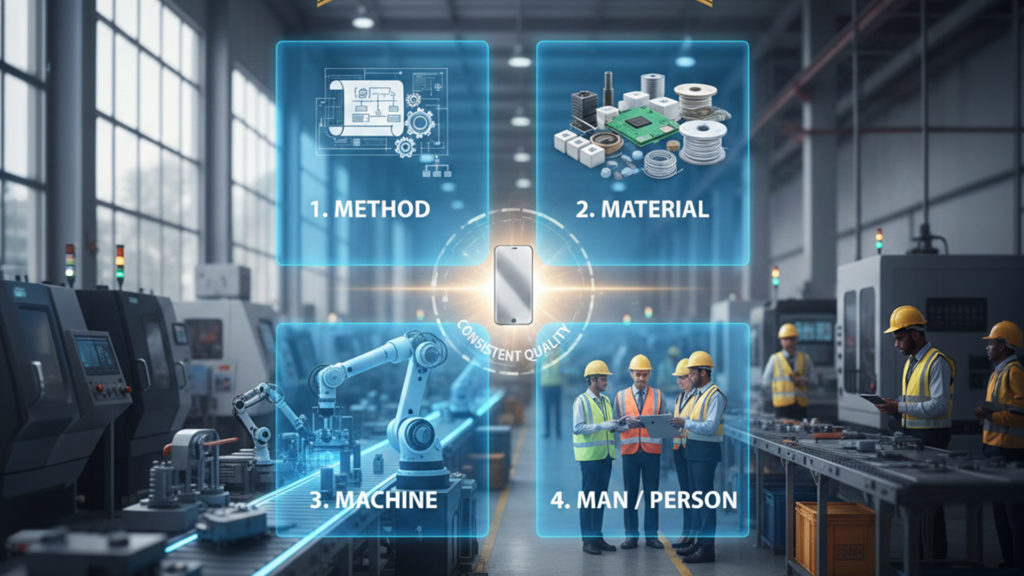
Have you ever wondered what goes on behind the scenes in a factory? Whether it’s a high-speed assembly line producing thousands of items or a specialized workshop crafting a single custom piece, the goal is always the same: to deliver consistent quality to the customer.
For those outside the industry, a factory floor might look like a complex maze of machines and people. However, there is a very logical "blueprint" that guides these operations. Today, let’s explore the fundamental concept that manufacturers use to ensure excellence—a framework known as the 4M.
The Heart of Production: Standardization
Whether a company produces goods in mass quantities or makes them to order, the most critical element is Standardization.
Standardization simply means deciding on the best way to do something and making sure that process is followed every time. Think of it like a professional kitchen. Without a standardized recipe, the taste of a dish would change depending on who is cooking. In manufacturing, standardization ensures that every customer receives a product that works perfectly, regardless of when it was made.
Introducing the 4Ms: The Four Pillars of Manufacturing
To achieve this standardization, manufacturers focus on four key elements. We call these the 4Ms. By organizing these four areas, we can create a reliable environment for making great products.
1. Method (The Way We Work)
Just like a recipe site helps you cook a new dish, a "Method" defines the steps of production. It’s the "how-to" of the factory. By defining the method first, we can identify exactly what materials and tools will be needed.
2. Material (The Ingredients)
Once the method is set, we determine the "Materials." This isn't just about the raw ingredients; it’s about ensuring the quality of every component. If the material changes, the way we process it might need to change too.
3. Machine (The Tools and Equipment)
Next, we consider the "Machines." Depending on what we are making, we need specific tools, jigs, or large-scale equipment. If you visit a large factory, you’ll notice that different production lines have different setups—this is because each machine is optimized for a specific product and method.
4. Man / Person (The Skilled Operator)
Finally, and most importantly, we have the "Man" (referring to the people involved). Even with the best machines and materials, we need skilled individuals to execute the work. When someone joins a new line or operates a new machine, they are given time to learn and practice. Investing in people's skills is what brings the other three Ms to life.
Why Do the 4Ms Matter to You?
You might ask, "Why should I care about the 4Ms?" The answer lies in Quality Stability.
As consumers, we pay for a product because we trust its performance. We expect the product we buy today to be just as good as the one bought yesterday. If a company provides a "great" product one day and a "broken" one the next, they lose the customer's trust.
The 4M framework is a tool for troubleshooting and improvement. If a defect occurs, engineers don't just guess what went wrong—they look at the 4Ms:
- Did the Method change?
- Was there a flaw in the Material?
- Did the Machine need maintenance?
- Did the Person need more training?
Building a Culture of Excellence
By understanding and optimizing the 4Ms, manufacturing becomes less about "working hard" and more about "working smart." It allows teams to reduce variation and focus on creating value.
Next time you see a product you love, take a moment to think about the 4Ms that went into it. Behind every great product is a balanced harmony of Methods, Materials, Machines, and People!
著者プロフィール

- 株式会社コルプ代表 / QA+編集長 Founder & CEO, QUALP Inc. / Editor-in-Chief, QA+
-
Takahiro Yoshida began his career in quality assurance at a precision equipment manufacturer in 2008, accumulating over 9 years of hands-on experience across mechanical hardware and embedded firmware. He led quality improvement initiatives in close collaboration with design and development teams, achieving measurable defect reduction through both process-stage quality building and mass-production-oriented approaches.
In 2018, he founded QUALP Inc., where he serves as Representative Director. Through the company's consulting arm, he supports small and medium-sized manufacturers in building organizational structures that reduce latent defect risk and absorb unforeseen cost pressures—drawing directly on his manufacturing floor experience to drive practical, lasting change.
He also runs QA+, a media platform for those who navigate the future through sound judgment and structural thinking.
この著者の書いた記事を読む
 Cases & Analysis2026年4月4日The Strait of Hormuz Blockade Has Exposed Japan's "Single Point of Failure" — Resource Dependency Structure and the Path Forward
 Cases & Analysis2026年4月4日Industry Halts, Supply Chains Seize — How the Strait of Hormuz Blockade Is Breaking Japan's Industrial Structure
 Conceptual Frameworks2026年2月8日The Foundation of Quality: Understanding the "4M" Framework in Manufacturing
 Industrial Praxis2026年1月26日Reclaiming the Value of the "Gemba" in the AI Era: The Future of Physical Labor at the Intersection of QA, Tech, and Business -Insights from Industrial Praxis (1): The Japanese Perspective on Physical Labor