

Originally Published in Japanese: April 2, 2026
- 1. Naphtha and LNG Shortages Are Now Visible
- 2. "When This Stops, Everything Stops": The Strait of Hormuz as a Single Point of Failure
- 3. What Individuals and Small Businesses Can Do Is Limited
- 3.1. Applications of Petrochemical Products
- 3.1.1. Hospitals and Healthcare
- 3.1.2. Agriculture and Food
- 3.1.3. Factories, Manufacturing, and Logistics
- 3.1.4. Home Appliances and Automotive
- 3.1.5. Daily Goods and Household Items
- 3.2. What Can Be Done Within These Constraints
- 4. Why Did This Dependency Structure Develop?
- 5. We Must Begin Acting in Parallel, Now
- 5.1. Energy Diversification: A Realistic Approach to Renewables and Nuclear Power
- 5.2. Material Diversification: Recycled Materials and Timber
- 6. Conclusion: Breaking Free from the "All-In-One-Place" Mindset
Naphtha and LNG Shortages Are Now Visible
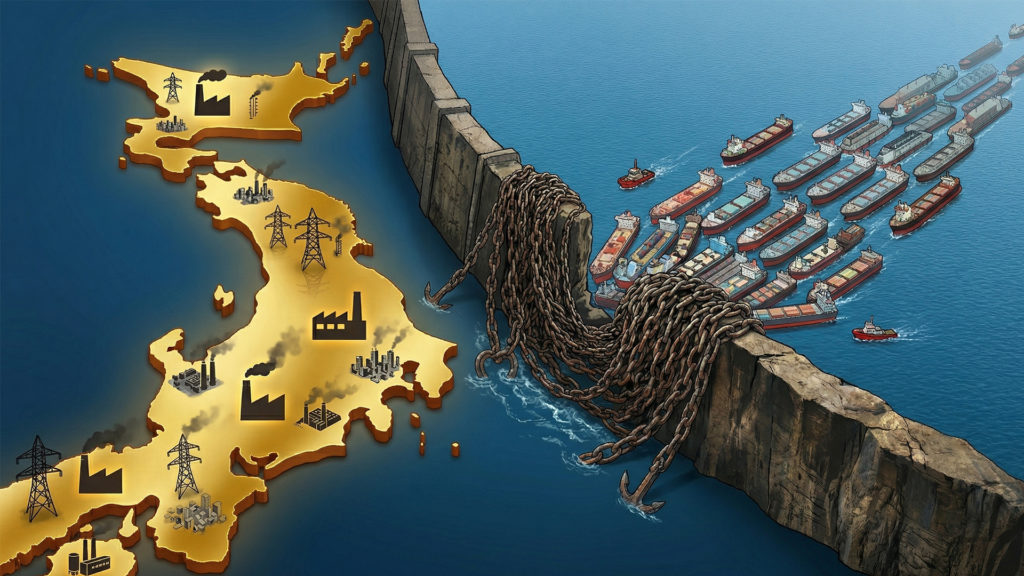
As of April 2026, the blockade of the Strait of Hormuz — triggered by U.S. and Israeli strikes on Iran and Iran's subsequent retaliation — remains unresolved. While crude oil shortages were the primary concern in the early stages, the prolonged situation has made it increasingly clear that the impact is spreading far more widely. What is now becoming visible is not only a crude oil shortage, but also shortages of liquefied natural gas (LNG) and naphtha, the feedstock for plastic products.
Naphtha is one of the fractions obtained in the crude oil refining process, but Japan has historically imported refined naphtha as a standalone product to meet domestic demand — and most of those import routes also pass through the Strait of Hormuz. The restrictions on naphtha imports have already reached a level where some plastic manufacturers have begun curtailing factory operations or are in the preparatory stages of doing so. If this continues, the likelihood of distribution restrictions on plastic products embedded in everyday Japanese life is increasing.
"When This Stops, Everything Stops": The Strait of Hormuz as a Single Point of Failure
In the field of systems design, there is a concept known as a "Single Point of Failure" (SPOF): a point in a process or system where, if that single point fails, the entire system stops — a point with no bypass or redundancy. Normally, systems are designed with duplication, redundancy, and failover mechanisms to prevent this. The Strait of Hormuz has now become exactly that — a SPOF for Japan's industry and supply chains.
When a system fails, the impact cascades downstream. Food packaging for processed foods and supermarket prepared meals, plastic pallets used in logistics, components for home appliances and automobiles, pharmaceutical packaging — plastics and materials derived from naphtha are woven into every aspect of society, and the ripple effects of their supply disruption are broader than most people can immediately imagine.
What Individuals and Small Businesses Can Do Is Limited
Under current circumstances, the options available to individuals and small businesses essentially come down to "reducing consumption." However, the critical question of "by how much?" remains unanswered. Because the government has not yet implemented distribution restrictions or supply rationing in the domestic market, consumers and frontline businesses have no quantitative benchmark — no way of knowing how much they can use, or how long current consumption rates are sustainable. The private sector is being forced to respond without any clear decision-making framework.
And even "reducing consumption" has its limits. Our society depends on petrochemical products derived from naphtha to such a degree that it cannot function without them. Below is a broad overview of the kinds of products made from petrochemicals across key sectors.
Applications of Petrochemical Products
Hospitals and Healthcare
- Syringes
- IV bags and tubing
- Gloves and masks
- Raw materials for pharmaceuticals such as aspirin
- Pharmaceutical intermediates; coatings for tablet surfaces; solvents and additives in ointments
Agriculture and Food
- Raw materials for agricultural chemicals (herbicides, pesticides, etc.)
- Film products such as greenhouse plastic sheeting
- Packaging for processed foods
- Bento box containers at supermarkets and convenience stores
- Food additives such as preservatives and antimicrobial agents
Factories, Manufacturing, and Logistics
- Lubricating oils for machinery; cutting oils used in metalworking
- Anti-rust agents applied to parts for corrosion prevention
- Paints and solvents
- Packaging materials such as labels and wrapping film
- Logistics equipment such as plastic pallets
- Sealing materials such as gaskets and packing
Home Appliances and Automotive
- Tires
- Electronic circuit boards
- Plastic components for vehicle interiors and exteriors
- Housing and switches for home appliances
Daily Goods and Household Items
- Raw materials for detergents, shampoos, and cosmetics
- Synthetic fibers used in clothing
- Water pipes
- Insulation for electrical wiring
- Substrates and adhesives for tapes
- Adhesives
- Wallpaper and wallpaper adhesives
What Can Be Done Within These Constraints
The reason these products can still be purchased without difficulty today is that manufacturers throughout the supply chain are carefully managing production — keeping factories running (because shutting down means months to restart), preventing market depletion, while also conserving raw materials.
As a realistic response, what citizens can do is: reduce their own heavy consumption of the above products to whatever extent is personally feasible, while continuing to demand clearer information disclosure and practical guidance from the government, large corporations, and especially the businesses involved in sourcing and importing these resources.
Why Did This Dependency Structure Develop?
At the root of it all was the overwhelming advantage of Middle Eastern crude oil: cheap, high-quality, and available in large quantities. Drawn by that advantage, Japan succeeded in dramatically lowering the cost of plastic products — while deepening its dependency on a single geopolitical bottleneck. Japan became so enamored with the "sweet deal" of Middle Eastern crude that it never came to terms with the risks and costs of securing alternative feedstocks, establishing alternative methodologies, or accepting the resulting price increases those alternatives would bring.
The social incentives to develop alternative routes and resources were simply weak as long as Middle Eastern dependency was working. But now, with the reality of "one point failing brings all of society to a halt" laid bare, that structural vulnerability has been definitively proven.
We Must Begin Acting in Parallel, Now
Japanese society tends toward the argument of "let's wait for things to calm down before thinking about this" — but with no certainty of when the blockade will end, there is no justification for deferring the search for solutions. Action must begin in parallel, starting now.
Energy Diversification: A Realistic Approach to Renewables and Nuclear Power
To reduce dependence on energy imports from the Middle East, it will be essential to build domestic systems for energy procurement and supply. Renewables such as solar and wind power are constrained in generation scale, but remain effective as a means of locally-sourced energy production. The use of next-generation materials like perovskite solar cells — lightweight and flexible, attracting significant attention in recent years — is also coming into scope.
Japan also needs to carefully and realistically reconsider the role of nuclear power. The resistance to nuclear fuel has historical and emotional roots that cannot be ignored. However, nuclear power operated under rigorous quantitative risk management still has a role to play in Japan's current energy mix. It will be necessary to study the experience of countries that have successfully increased their share of renewable energy, and to continue refining methodologies with persistence.
The spread of electric vehicles (EVs) also warrants reassessment in this context. Given that the diversification of power generation methods described above makes local energy production feasible, Japan is a society where increasing EV adoption carries genuine merit.
Material Diversification: Recycled Materials and Timber
On the materials side, more aggressive use of recycled materials is needed. The Japan Plastics Industry Federation published the following explanation of recycled plastic materials in a release accompanying their 2023 Material Flow Chart:
The breakdown of the 89% effective utilization rate is as follows: material recycling 22%, chemical recycling 3%, thermal recycling (energy recovery) 64%. To further improve the effective utilization rate, it will be necessary to incorporate the 11% (810,000 tonnes) currently going to simple incineration (8%: 580,000 tonnes) and landfill (3%: 240,000 tonnes) into the recycling stream. Meanwhile, exported waste plastics used as material recycling destinations totaled 1.25 million tonnes — 540,000 tonnes as plastic scrap and 710,000 tonnes as recycled raw materials — accounting for approximately 70% of all material-recycled products.
"Total waste plastic generation in 2023 was 7.69 million tonnes; effective utilization rate was 89%" — Publication of the "Status of Production, Disposal, Recycling, and Processing of Plastic Products (Material Flow Chart)" — December 23, 2024, Japan Plastics Industry Federation
[Translated by QA+]
The challenge with recycled materials is quality variability. Maintaining consistent performance and properties at a stable level is difficult, and this has been one of the reasons recycled material adoption has lagged. Finished product manufacturers have been known to instruct suppliers to "prohibit the use of recycled materials" citing quality stability concerns — the author has personally seen such specifications on technical drawings in the past.
But now, with the realities of "a distant country may stop selling to us" and "the ships carrying the goods may not be able to move" being thrust upon us, the situation where recycled materials must be used — where serious effort must be invested in stabilizing their quality — is drawing closer.
Japan also has a distinctive strength in timber resources. Since domestic timber fell out of favor as a construction material, many forests have gone poorly managed — but with appropriate utilization, their potential as industrial materials is considerable. Composite materials combining plastics and wood, and interior materials that leverage the natural character of wood, are already seeing growing application in industrial products. The use of timber could also serve as an economic foundation for a new era of forest management in Japan.
Conclusion: Breaking Free from the "All-In-One-Place" Mindset
Japan has a tendency: when a material or technology is found to be superior, society rushes to concentrate on it all at once. Middle Eastern crude oil dependency is one example; marine resources are another, where catch limits have failed to keep pace with growing market demand and overfishing has effectively progressed. We must anticipate that the moment timber is reassessed, excessive harvesting could follow — which makes it essential to build operations that enable planned, sustainable extraction.
What Japan truly needs going forward is not "this material works, so let's switch everything over to it" — but resource management that keeps the full balance in view, with an awareness of both societal needs and resource security. Understanding what resources our lives depend on, and how energy and materials move through their cycles — and managing that consciously, as a society. That is the fundamental question this crisis is asking of us.
In major metropolitan areas like Tokyo and Osaka, the realities of manufacturing and primary industries are hard to see. The bill for a society that has allowed itself to be "indifferent" to what sustains its infrastructure is now coming due.
For those who want to first understand what is happening — start here.
For those who want to first understand what is happening — start here.

Industry Halts, Supply Chains Seize — How the Strait of Hormuz Blockade Is Breaking Japan's Industrial Structure
Originally Published in Japanese: March 25, 2026 / Last updated: April 2, 2026 Plastics… Food… A Distant War Shaking Japan's Daily Life On February 28, 2026, the United States and Israel launched strikes against Iran. The resulting blockade of the Strait of Hormuz is now producing concrete effects on Japan's economy. In the petrochemical sector, […]

著者プロフィール

- 株式会社コルプ代表 / QA+編集長 Founder & CEO, QUALP Inc. / Editor-in-Chief, QA+
-
Takahiro Yoshida began his career in quality assurance at a precision equipment manufacturer in 2008, accumulating over 9 years of hands-on experience across mechanical hardware and embedded firmware. He led quality improvement initiatives in close collaboration with design and development teams, achieving measurable defect reduction through both process-stage quality building and mass-production-oriented approaches.
In 2018, he founded QUALP Inc., where he serves as Representative Director. Through the company's consulting arm, he supports small and medium-sized manufacturers in building organizational structures that reduce latent defect risk and absorb unforeseen cost pressures—drawing directly on his manufacturing floor experience to drive practical, lasting change.
He also runs QA+, a media platform for those who navigate the future through sound judgment and structural thinking.
この著者の書いた記事を読む
 Cases & Analysis2026年4月4日The Strait of Hormuz Blockade Has Exposed Japan's "Single Point of Failure" — Resource Dependency Structure and the Path Forward
 Cases & Analysis2026年4月4日Industry Halts, Supply Chains Seize — How the Strait of Hormuz Blockade Is Breaking Japan's Industrial Structure
 Conceptual Frameworks2026年2月8日The Foundation of Quality: Understanding the "4M" Framework in Manufacturing
 Industrial Praxis2026年1月26日Reclaiming the Value of the "Gemba" in the AI Era: The Future of Physical Labor at the Intersection of QA, Tech, and Business -Insights from Industrial Praxis (1): The Japanese Perspective on Physical Labor